

Quick Answer
Hyperpigmentation is the broad medical term for skin that becomes darker because of excess melanin. Melasma is one specific type of hyperpigmentation, usually appearing as symmetrical brown or grey-brown patches on the cheeks, forehead, upper lip, nose bridge, or jawline. In simple words: all melasma is hyperpigmentation, but not all hyperpigmentation is melasma.
The difference matters because acne marks, sunspots, freckles, and melasma do not behave the same way. They have different triggers, different fading timelines, different risks on South Asian skin, and different treatment plans. Treating every dark mark as “pigmentation” is one reason people waste months on the wrong creams, harsh scrubs, or procedures that make the patches return darker.
Why This Comparison Matters for South Asian Skin
If you live in Karachi or anywhere with strong year-round sun exposure, uneven skin tone can be confusing. One person may have brown acne marks after breakouts. Another may have soft, cloud-like patches across both cheeks after pregnancy, oral contraceptives, heat exposure, or years of sun. A third may have small sunspots from cumulative UV damage. All of these can be described casually as “pigmentation,” but they are not the same condition.
South Asian skin tones usually contain more active melanin than very fair skin. That melanin is protective in many ways, but it also means the skin can pigment strongly after inflammation, irritation, sun exposure, waxing, acne, aggressive facials, unregulated whitening creams, or incorrect laser settings. This is why the first step is not choosing a treatment. The first step is identifying the pattern.
For a broader guide on the common triggers behind facial pigmentation, connect this article internally to Caviar’s guide on what causes pigmentation on the face. This article should serve a different purpose: helping readers understand whether their dark patches are likely melasma, post-inflammatory hyperpigmentation, sunspots, or another pigment concern that needs professional assessment.
Hyperpigmentation vs Melasma at a Glance
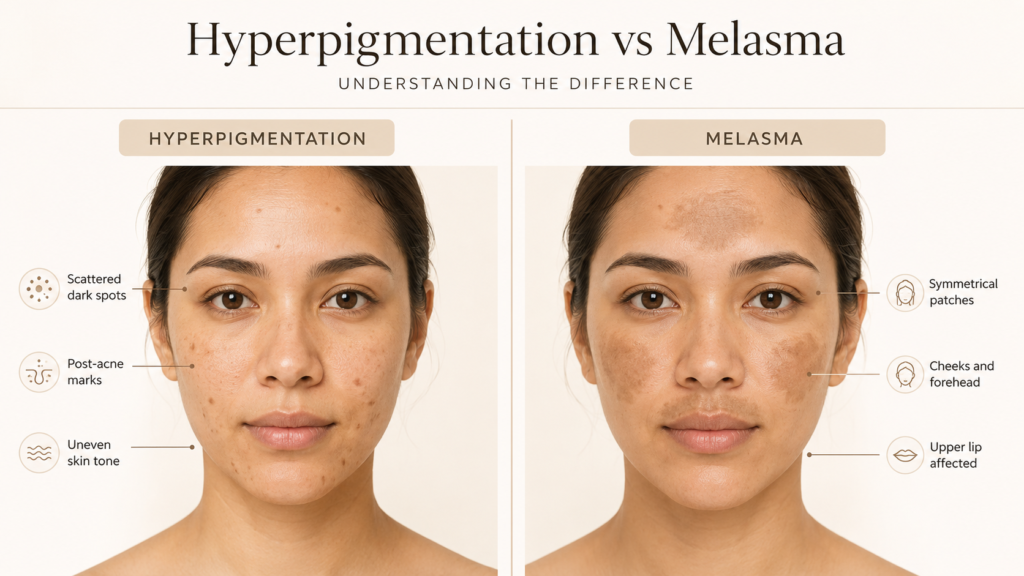
| Feature | Hyperpigmentation | Melasma |
| Meaning | An umbrella term for darker areas of skin caused by excess melanin. | A specific pigment disorder and one type of hyperpigmentation. |
| Common appearance | Small spots, patches, marks, freckles, acne marks, sunspots, or uneven tone. | Blotchy, brown or grey-brown patches, usually soft-edged and symmetrical. |
| Typical pattern | Can be scattered, one-sided, localized, or linked to a previous injury or breakout. | Often appears on both sides of the face, especially cheeks, forehead, upper lip, and nose bridge. |
| Main triggers | Acne, eczema, burns, cuts, sun damage, medications, hormones, inflammation, or aging. | Sunlight, visible light, heat, hormones, pregnancy, contraceptives, genetics, and recurrence tendency. |
| Fading timeline | Depends on depth. Surface marks may fade in months; deeper pigment can take years. | Often chronic and recurrent. It may improve, flare, and require long-term maintenance. |
| Treatment focus | Treat the cause, reduce inflammation, protect from sun, and fade existing pigment. | Control triggers, protect from UV and visible light, regulate pigment production, and maintain results. |
| Biggest mistake | Using harsh products that irritate the skin and create more dark marks. | Treating it like simple dark spots and stopping protection once it fades. |
What Is Hyperpigmentation?
Hyperpigmentation means an area of skin has become darker than the surrounding skin. The color change happens when the skin produces too much melanin or deposits that pigment unevenly. It can show up as brown, black, grey, red-brown, or pinkish-brown marks depending on your natural skin tone, the depth of pigment, and the original trigger.
This is not one single condition. It is a descriptive term. Saying “I have hyperpigmentation” is like saying “I have swelling.” It tells us what we can see, but not why it happened. The real question is: what type of hyperpigmentation is it?
Common Types of Hyperpigmentation
- Post-inflammatory hyperpigmentation (PIH): Dark marks left after acne, eczema, burns, cuts, waxing irritation, insect bites, rashes, or aggressive procedures.
- Sunspots or solar lentigines: Flat brown spots caused by years of UV exposure, usually appearing on sun-exposed areas such as the face, hands, shoulders, and chest.
- Freckles: Small genetic spots that usually darken with sun exposure and may become more visible in warmer months.
- Melasma: Symmetrical facial patches influenced by hormones, sun exposure, visible light, heat, and genetic tendency.
- Drug-related or medical pigmentation: Some medications, vitamin deficiencies, thyroid disorders, or hormonal conditions can contribute to diffuse or patchy pigmentation and should be assessed by a clinician.
Is hyperpigmentation dangerous?
Most hyperpigmentation is harmless, but new, changing, irregular, painful, bleeding, or rapidly growing spots should be checked by a qualified medical professional. Cosmetic dark spots can look similar to other skin changes, so diagnosis matters before treatment.
What Is Melasma?
Melasma is a common acquired pigmentation disorder that creates blotchy brown, tan, or grey-brown patches, especially on sun-exposed areas of the face. It is often called the “mask of pregnancy,” but pregnancy is only one possible trigger. Many people develop melasma without ever being pregnant.
The classic clue is symmetry. Melasma often appears on both cheeks, across the forehead, above the upper lip, on the nose bridge, or along the jawline. The edges can look soft and cloud-like rather than sharply defined. It may get darker after sun, heat, outdoor events, beach trips, hormonal changes, or inconsistent sunscreen use.
Melasma is not simply “dirt,” “dead skin,” or a lack of fairness. It is a pigment regulation problem. The melanocytes behave as if they are over-alert. Even after patches fade, the same area may darken again if the trigger returns. That is why melasma needs maintenance, not only a one-time brightening treatment.
Why Melasma Comes Back So Often
Melasma is stubborn because it is usually multi-factorial. A cream may reduce visible pigment, but if sun exposure, heat, visible light, hormonal influence, irritation, or inflammation continues, the signal to produce pigment remains active. This is why users often say, “It improved for a while, then came back.” The skin did not fail. The plan did not control the full trigger cycle.
For internal linking, this is the natural place to guide readers toward Caviar’s article on why pigmentation keeps coming back, because recurrence is one of the biggest user questions around melasma.
The 7 Biggest Differences Between Hyperpigmentation and Melasma
1. Hyperpigmentation is a category; melasma is a diagnosis
Hyperpigmentation describes the visible result: extra pigment. Melasma describes a specific pattern and behavior of pigment. This distinction is important for SEO and patient education because many users search “pigmentation” when they actually need help identifying the subtype. A good article should clarify that the word pigmentation is not enough to choose a treatment.
2. Hyperpigmentation may follow an obvious event; melasma may not
Post-acne marks are easier to trace: a pimple was there, it healed, and now a brown mark remains. A burn, rash, scratch, or threading irritation can leave a similar mark. Melasma can feel more mysterious. It may appear gradually without a clear injury. The user may only notice that both cheeks look darker, the upper lip looks shadowed, or the forehead has uneven brown patches.
3. Melasma is usually more symmetrical
Symmetry is one of the strongest visual clues. If the same type of patch appears on both cheeks, both sides of the forehead, or both sides of the upper lip area, melasma becomes more likely. Hyperpigmentation from acne or injury is often scattered and follows where the inflammation happened. It may be one-sided, clustered around old breakouts, or limited to the exact area of a burn or rash.
4. Melasma is more trigger-sensitive
A post-acne mark may darken in the sun, but once the acne is controlled and the skin is protected, it often fades gradually. Melasma is more reactive. It can flare after sunlight, heat, visible light, hormonal changes, stress, pregnancy, contraceptives, or irritating skincare. A reader who says, “My pigmentation improves in winter but returns in summer,” may be describing melasma behavior.
5. Hyperpigmentation can be superficial or deep; melasma can involve multiple skin layers
The depth of pigment affects treatment speed. Surface pigment in the epidermis usually responds faster to topical ingredients and gentle exfoliation. Deeper pigment in the dermis can look grey-brown, blue-grey, or more shadow-like, and it usually takes longer to improve. Melasma may involve epidermal pigment, dermal changes, vascular influence, and chronic sun-related skin changes, which is why a simple “brightening” routine often underperforms.
6. Treatment goals are different
For many forms of hyperpigmentation, the goal is to stop the original cause and fade the remaining mark. For example, if acne is creating brown marks, acne control is part of pigment treatment. If a harsh product is burning the skin, removing irritation is the first treatment. With melasma, the goal is broader: calm the melanocytes, reduce visible pigment, control environmental triggers, protect from UV and visible light, and prevent relapse.
7. Melasma needs long-term maintenance
The most realistic way to explain melasma is this: it can be managed beautifully, but it has a memory. Once skin has a melasma tendency, stopping sunscreen, restarting irritating products, or spending time in strong heat can reactivate the patches. A good melasma plan includes treatment and maintenance. This expectation setting builds trust and prevents users from feeling misled.
How to Tell What You Might Have Before Seeing a Professional

No blog can diagnose your skin with certainty, but pattern recognition can help you ask better questions during consultation. Use this checklist as an educational guide:
| If you notice… | It may suggest… |
| Dark marks exactly where acne, rash, burns, or cuts healed | Post-inflammatory hyperpigmentation |
| Flat brown spots on sun-exposed areas after years outdoors | Sunspots or solar lentigines |
| Small spots that run in families and darken with sun | Freckles |
| Mirror-like patches on both cheeks, forehead, upper lip, or nose bridge | Melasma |
| Pigment that worsens with heat, summer, pregnancy, contraceptives, or sun | Melasma tendency |
| Velvety darkening around neck folds or underarms | Acanthosis nigricans or metabolic/hormonal concern; needs medical assessment |
| Sudden widespread darkening with fatigue, weight changes, or other symptoms | A medical cause that should be evaluated |
Can You Have Both Hyperpigmentation and Melasma?
Yes. This is common and important. A person may have melasma on the cheeks and post-acne hyperpigmentation on the chin. Another person may have sunspots on the temples and melasma over the upper lip. Treating only one pattern can make the overall result look incomplete.
This is also why the same treatment does not work equally across the whole face. The cheek patches may need melasma-focused control, while acne marks need acne prevention, barrier repair, and fading ingredients. A professional skin assessment can separate these patterns so the plan is not random.
How Professionals Differentiate Melasma From Other Pigmentation
A proper pigmentation consultation usually looks at more than color. It considers pattern, depth, triggers, medication history, pregnancy or hormonal history, skincare routine, sun habits, previous treatments, irritation history, and whether the pigment is stable or worsening.
Key assessment points include:
- Distribution: Is the pigment symmetrical or scattered?
- Trigger history: Did it start after acne, pregnancy, sun exposure, a peel, laser, medication, or irritation?
- Depth clues: Is it light brown and surface-looking, or grey-brown and shadow-like?
- Skin type: Darker skin tones need extra caution with lasers, aggressive peels, and strong actives.
- Current routine: Fragrance, scrubs, steroid-mixed creams, bleaching products, or overuse of acids can worsen pigmentation.
- Medical context: Thyroid concerns, vitamin deficiencies, hormonal conditions, pregnancy, and certain medications may influence pigmentation.
Some clinics may use tools such as a Wood lamp, dermoscopy, digital skin analysis, or structured facial imaging to better understand the pattern. At Caviar by Dr. Ambreen Roshan, skin analysis is positioned as part of a personalized approach rather than a one-size-fits-all treatment choice. Keep this mention soft and educational, not sales-heavy.
Treatment: Why the Same Cream or Procedure Does Not Work for Everyone
The treatment gap between hyperpigmentation and melasma is where many users make mistakes. They see a dark patch and immediately search for whitening cream, peel, laser, or home remedy. But pigment is not only a color issue. It is a cause-and-trigger issue.
Treatment Approach for General Hyperpigmentation
For non-melasma hyperpigmentation, the plan depends on the cause. Post-acne marks require acne control first. Pigment from eczema requires calming inflammation. Sunspots require strict sun protection and may respond to targeted procedures. Drug-related pigment needs medical review. Irritation-induced pigment needs barrier repair and stopping the irritating product.
A sensible plan may include daily sunscreen, gentle cleansing, barrier-supporting moisturizer, dermatologist-approved brightening ingredients, acne or rash control if needed, and professional treatments only when the skin is stable. Ingredients often discussed for dark marks include azelaic acid, vitamin C, retinoids, kojic acid, glycolic acid, and prescription options when appropriate. The right choice depends on skin tolerance and the type of pigment.
Treatment Approach for Melasma
Melasma treatment is usually more layered. It may include strict photoprotection, tinted sunscreen with visible-light protection, topical pigment regulators, anti-inflammatory support, barrier repair, and carefully selected procedures. Some patients may be candidates for prescription creams, chemical peels, tranexamic acid under medical supervision, laser or energy-based treatments, or depigmentation systems such as Cosmelan when suitable.
Because melasma can relapse, readers who want a deeper treatment-specific explanation can be linked to Cosmelan Peel for melasma and the Caviar service page for Cosmelan Peel treatment. Keep this as an optional next read rather than the main purpose of the article.
Important Note on Lasers and Peels
Lasers and peels can be useful, but they are not automatically safe for every pigment type. On South Asian skin, aggressive treatment can irritate melanocytes and cause post-inflammatory hyperpigmentation. This is especially relevant when the skin barrier is already weak or when someone has active melasma. The safest approach is conservative, pattern-based, and supervised by a qualified professional.
This paragraph should internally link to Caviar’s comparison article on laser skin whitening vs chemical peel and, where relevant, the educational guide on how chemical peels brighten skin safely. For users considering laser options, link once to the guide on safe laser solutions for glowing skin. Do not over-link all three in one published paragraph if it feels crowded; choose the most natural one based on final layout.
The Sunscreen Difference: Why Melasma Needs Extra Protection
Sunscreen is important for all hyperpigmentation, but it is non-negotiable for melasma. In regular dark spots, sunscreen helps prevent marks from getting darker and supports fading. In melasma, sunscreen is also part of relapse control. Without it, even effective treatments may not hold.
For melasma-prone skin, broad-spectrum sunscreen is the base. Tinted sunscreen containing iron oxides can be especially helpful because visible light can worsen melasma, particularly in darker skin tones. This is a practical AEO point because many users ask, “Why is my melasma worse even though I use sunscreen?” One possible answer is that the sunscreen may not protect well enough from visible light, may not be applied in sufficient quantity, or may not be reapplied during outdoor exposure.
Simple daily protection rules
- Use broad-spectrum SPF every morning, even on cloudy days.
- For melasma, consider tinted sunscreen with iron oxides, especially if patches worsen despite regular SPF.
- Reapply when outdoors, sweating, or exposed for long periods.
- Use sunglasses, shade, wide-brimmed hats, and physical protection where possible.
- Avoid unnecessary heat exposure when melasma is active, including prolonged direct sun, hot environments, and irritating treatments.
Common Mistakes That Make Pigmentation or Melasma Worse
- Using harsh scrubs. Scrubbing does not remove melasma. It can irritate the skin and trigger more pigment.
- Trying steroid-mixed whitening creams without medical supervision. These may temporarily lighten but can thin the skin, trigger acne, cause redness, and worsen rebound pigmentation.
- Changing products every week. Pigment takes time. Constant switching creates irritation and makes it harder to know what is helping.
- Skipping sunscreen once pigment improves. This is one of the fastest ways for melasma to return.
- Treating acne marks without treating acne. New breakouts keep creating new pigment.
- Doing strong peels or lasers without diagnosis. The wrong procedure can create PIH, especially on melanin-rich skin.
- Expecting overnight clearing. Surface marks may take months; deeper pigment and melasma can require long-term management.
What Results Can You Realistically Expect?
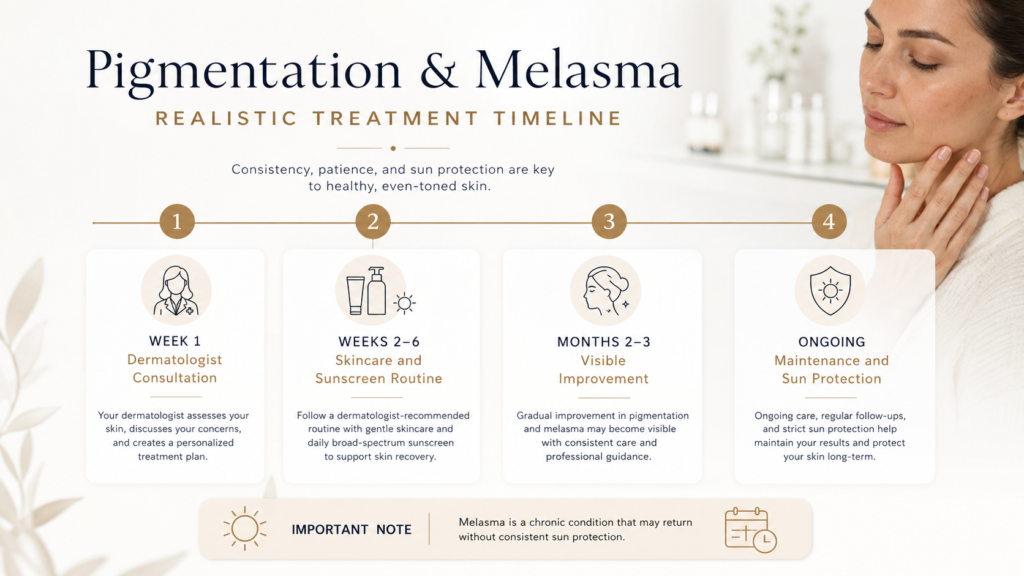
Expectations should be honest. Hyperpigmentation can improve, but the timeline depends on pigment depth, trigger control, skin type, inflammation, and consistency. Mild post-acne marks may fade gradually over months with sunscreen and a proper routine. Deeper PIH may take much longer. Sunspots may need targeted professional options. Melasma can improve significantly but often needs ongoing maintenance because it is trigger-prone.
A realistic goal is not to erase the skin’s natural color. The goal is to reduce excess pigment, even the tone, prevent new darkening, protect the skin barrier, and maintain a healthy result. This language is important for Caviar’s positioning because it avoids unsafe “instant whitening” claims and sounds more clinically trustworthy.
When Should You See a Skin Professional?
You should consider a professional skin assessment if the pigmentation is spreading, returning again and again, appearing symmetrically on both sides of the face, following pregnancy or hormonal medication, not improving after months of sunscreen and gentle skincare, or getting worse after home remedies, facials, creams, peels, or laser.
You should also seek medical review for any spot that changes rapidly, bleeds, becomes painful, has irregular borders, looks very different from your other marks, or appears with other symptoms such as fatigue, sudden weight changes, menstrual irregularity, or widespread skin darkening.
At Caviar by Dr. Ambreen Roshan in DHA Phase 6, Karachi, the most helpful starting point is not choosing a treatment from a menu. It is understanding your pigment pattern first. Once the type of pigmentation is clearer, treatment options can be discussed more responsibly, whether that means skincare, medical-grade peels, pigment-focused protocols, laser caution, or simple maintenance advice.
Final Takeaway
Hyperpigmentation and melasma are connected, but they are not the same. Hyperpigmentation is the umbrella term for excess darkening. Melasma is a specific, recurring, trigger-sensitive type of hyperpigmentation that usually appears as symmetrical facial patches. If you understand that difference, you are less likely to waste time on the wrong products and more likely to choose a safe, long-term plan.
For users, the smartest question is not “Which cream removes pigmentation fast?” The smarter question is “What type of pigmentation do I have, what is triggering it, and how can I stop it from returning?” That is the question this article should answer better than competing pages.
FAQs
Is melasma the same as hyperpigmentation?
No. Melasma is one type of hyperpigmentation. Hyperpigmentation is the broader term for any area of skin that becomes darker due to excess melanin. Melasma has a more specific pattern, usually symmetrical brown or grey-brown patches on the face.
How do I know if my dark patches are melasma?
Melasma is more likely if the patches appear on both sides of the face, especially on the cheeks, forehead, upper lip, nose bridge, or jawline. It may also worsen with sun, heat, pregnancy, contraceptives, or hormonal changes. A skin professional can confirm the pattern.
Can acne marks be confused with melasma?
Yes, but acne marks usually follow the exact location of previous pimples and are often scattered. Melasma is usually more symmetrical and patch-like. Some people have both acne-related hyperpigmentation and melasma at the same time.
Does melasma go away permanently?
Melasma can fade, but it often has a tendency to return when triggers are not controlled. Long-term sun protection, visible-light protection, gentle skincare, and maintenance treatment are usually important.
What makes melasma worse?
Common triggers include UV exposure, visible light, heat, pregnancy, hormonal medication, genetics, stress, skin irritation, and stopping sunscreen after improvement.
What is the fastest way to fade hyperpigmentation?
The safest fast approach is accurate diagnosis, daily sun protection, stopping the trigger, and using evidence-based ingredients or professional treatments suitable for your skin type. Harsh bleaching or aggressive peeling may worsen pigment.
Is sunscreen really necessary for pigmentation?
Yes. Sunscreen helps prevent dark spots from getting darker and supports fading. For melasma, tinted sunscreen with iron oxides may be helpful because visible light can worsen patches in darker skin tones.
Are lasers safe for melasma?
Lasers may help selected patients, but they must be chosen carefully, especially for South Asian skin. Incorrect settings or aggressive energy can trigger post-inflammatory hyperpigmentation. Melasma often needs a conservative, supervised plan.
Can chemical peels treat melasma and hyperpigmentation?
Chemical peels can help some forms of superficial pigmentation, but the peel type, depth, skin condition, and aftercare matter. Strong or poorly chosen peels can irritate the skin and worsen pigment.
Should I treat pigmentation at home first or see a professional?
If the marks are mild and clearly linked to acne, gentle skincare and sunscreen may help. If patches are symmetrical, recurring, worsening, or not improving, a professional assessment is safer and more effective.