

When it comes to weight loss, understanding how to calculate calories is essential for achieving sustainable and healthy results. Losing weight is not just about cutting down calories, but finding the right balance to ensure you are nourishing your body while still creating a caloric deficit. This guide will provide you with a comprehensive, step-by-step approach to calculating calories for healthy weight loss, including important tips, tools, and common mistakes to avoid.
What is a Calorie?
A calorie is a unit of measurement that tells us how much energy food provides. Your body uses calories to perform basic functions, like breathing and digesting food, and to fuel physical activities. The number of calories you need depends on several factors, including your age, gender, weight, height, and activity level.
Why is Calorie Calculation Important for Weight Loss?
To lose weight, you must consume fewer calories than your body needs. This is known as creating a caloric deficit. When your body is in a caloric deficit, it taps into its energy stores (mainly fat) to make up for the shortfall, leading to weight loss. However, the goal is to do this in a healthy and sustainable way, which is why tracking your calories effectively is so important.
Step 1: Determine Your Basal Metabolic Rate (BMR)
Your BMR is the number of calories your body needs to perform basic functions like breathing, maintaining body temperature, and digesting food. It is essentially the amount of energy you burn while at rest.
How to Calculate Your BMR
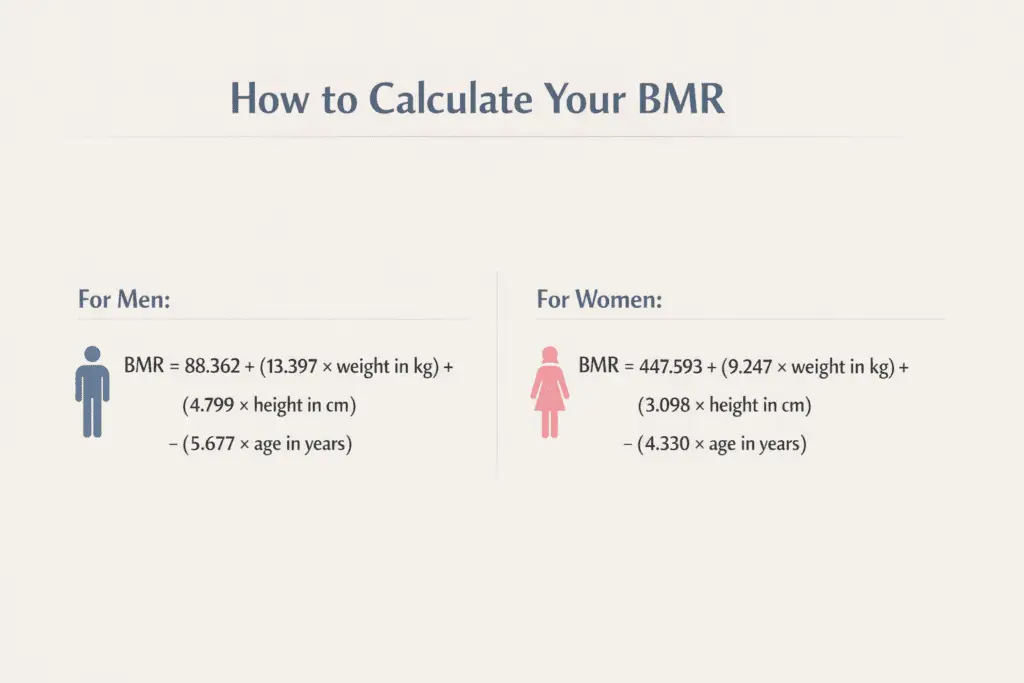
The most common way to estimate your BMR is through the Harris-Benedict Equation. There are different formulas for men and women:
- For men:
[ BMR = 88.362 + (13.397 times weight in kg) + (4.799 times height in cm) – (5.677 times age in years) ] - For women:
[ BMR = 447.593 + (9.247 times weight in kg) + (3.098 times height in cm) – (4.330 times age in years) ]
Alternatively, you can use an online BMR calculator to quickly find your result.
Step 2: Calculate Your Total Daily Energy Expenditure (TDEE)
Your TDEE is the total number of calories you burn each day, including the calories burned from physical activity. To determine your TDEE, you need to factor in your activity level. This is done by multiplying your BMR by an activity factor:
- Sedentary (little or no exercise): BMR × 1.2
- Lightly active (light exercise/sports 1-3 days/week): BMR × 1.375
- Moderately active (moderate exercise/sports 3-5 days/week): BMR × 1.55
- Very active (hard exercise/sports 6-7 days a week): BMR × 1.725
- Super active (very hard exercise or a physically demanding job): BMR × 1.9
For example, if your BMR is 1,500 calories and you are moderately active, your TDEE would be:
[ 1,500 times 1.55 = 2,325 text{ calories/day} ]
This is the number of calories you need to maintain your current weight.
Step 3: Set a Caloric Deficit for Weight Loss
To lose weight, you must create a caloric deficit, which means consuming fewer calories than your TDEE. A safe and effective calorie deficit is usually between 500 and 1,000 calories per day. This will result in a weight loss of about 1 to 2 pounds per week, which is considered healthy and sustainable.
For example, if your TDEE is 2,325 calories, aiming for a 500-calorie deficit would mean consuming about 1,825 calories per day.
- 500-calorie deficit: TDEE – 500 = 1,825 calories/day (approx. 1 pound of weight loss per week)
- 1,000-calorie deficit: TDEE – 1,000 = 1,325 calories/day (approx. 2 pounds of weight loss per week)
It’s important to note that drastic calorie reductions below your TDEE can slow down metabolism, cause muscle loss, and lead to nutritional deficiencies. Therefore, aim for a moderate deficit.
Step 4: Track Your Calories
Tracking your calories is crucial to ensure you are staying within your target range. You can use several tools to do this:
- Mobile apps: Apps like MyFitnessPal, Lose It!, or Cronometer allow you to log your food intake, track calories, and monitor macronutrients (proteins, fats, and carbohydrates).
- Food scales and labels: Using a food scale to measure portions and reading nutrition labels can provide accurate information about the calorie content of your food.
- Meal prep: Preparing meals ahead of time helps you control portions and prevents overeating.
Step 5: Focus on Nutrient-Dense Foods
While counting calories is important, the quality of your calories matters too. Aim to consume nutrient-dense foods that are rich in vitamins, minerals, fiber, and protein, while being lower in empty calories (sugary, processed foods).
- Protein: Protein helps preserve muscle mass and keeps you feeling fuller longer. Sources include lean meats, fish, eggs, beans, and legumes.
- Healthy fats: Include sources of healthy fats such as avocados, nuts, seeds, and olive oil. These fats support hormone function and keep you satisfied.
- Fiber: Foods high in fiber, such as vegetables, fruits, whole grains, and legumes, are filling and aid in digestion.
Step 6: Adjust as Needed
Your caloric needs can change over time. As you lose weight, your BMR will decrease, meaning you may need to adjust your calorie intake. Additionally, changes in activity level, age, or metabolic adaptations may require recalculating your calorie goals.
Regularly track your progress (e.g., weight, body measurements, or fitness levels) to determine whether you need to make adjustments.
Common Mistakes to Avoid When Calculating Calories for Weight Loss
- Underestimating portion sizes: It’s easy to underestimate how many calories are in a meal, especially when eating out or consuming packaged foods. Always measure portions when possible.
- Neglecting non-exercise activity: Non-exercise activities, like walking or standing, also contribute to your total calorie expenditure. Consider using a pedometer or fitness tracker to track your steps.
- Focusing solely on calorie counting: Calorie counting alone doesn’t guarantee weight loss success. Focus on overall healthy eating, staying active, and managing stress.
- Ignoring the quality of calories: Not all calories are equal. 100 calories from vegetables provide more nutrition and fullness than 100 calories from processed junk food.
Step 7: Make Healthy Weight Loss a Lifestyle
For long-term success, weight loss should be seen as a lifestyle change, not a short-term fix. Once you’ve reached your weight loss goal, focus on maintaining a healthy balance of calories, exercise, and mindful eating.
Sustainable Practices for Healthy Weight Loss:
- Eat a balanced diet: Include a variety of nutrient-dense foods in your meals, such as vegetables, fruits, whole grains, lean proteins, and healthy fats.
- Exercise regularly: Incorporate both cardio and strength training exercises to maintain muscle mass and support fat loss.
- Prioritize sleep and stress management: Poor sleep and high stress can hinder weight loss by affecting hormones that regulate hunger and metabolism.
An Option for Targeted Fat Reduction
In addition to a well-balanced diet and regular exercise, many individuals are turning to advanced aesthetic treatments to help with stubborn fat areas that are difficult to reduce through traditional methods. One such treatment gaining popularity is the Fat Dissolving Injection. This non-invasive procedure targets localized fat deposits, helping to break down fat cells and naturally eliminate them from the body. Caviar by Dr Ambreen Roshan offers a professional and safe approach to this treatment, helping clients achieve a more sculpted and contoured appearance without the need for surgery. If you’re struggling with areas of fat that won’t budge, this treatment could be a valuable option to enhance your weight loss efforts while maintaining a healthy lifestyle.
Conclusion
Calculating calories is an essential part of any healthy weight loss journey, but it’s just one piece of the puzzle. By determining your BMR, calculating your TDEE, and setting a healthy caloric deficit, you can create a sustainable plan for losing weight. Along the way, prioritize nutrient-dense foods, regular physical activity, and lifestyle changes that support your overall well-being. Remember, the key to healthy weight loss is consistency, patience, and taking a balanced approach to your diet and exercise routine.
By following this step-by-step guide, you can embark on a successful and sustainable weight loss journey that not only helps you shed pounds but also improves your overall health.
Related: