

You may be eating carefully, exercising regularly and maintaining a stable weight, yet still notice a pocket of fat beneath your chin, around your abdomen or along your arms. These localised deposits are commonly described as stubborn fat because they may not change as quickly as the rest of the body. Two frequently considered solutions are fat-dissolving injections and liposuction. Both are designed to improve body contours, but they work differently and are suitable for different goals. Fat-dissolving injections are minimally invasive and are normally considered for smaller, well-defined pockets of fat. Liposuction is a surgical procedure that can remove a greater volume of fat and usually produces more significant contouring in a single procedure. Therefore, the better option depends on the amount of fat present, the treatment area, skin quality, expected result, medical history and how much recovery time a person can accommodate.
Fat Dissolving Injections vs Liposuction at a Glance
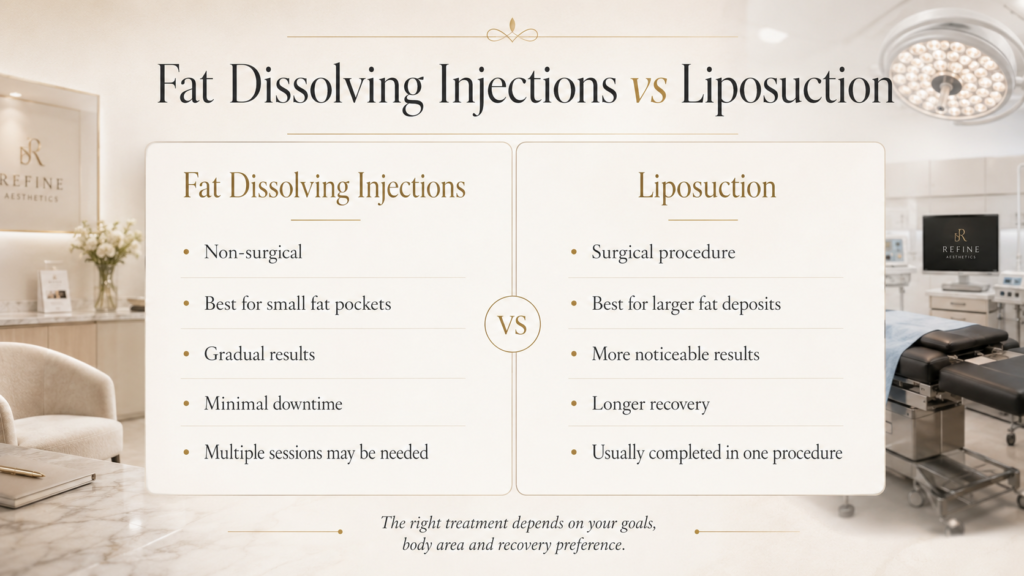
| Factor | Fat-Dissolving Injections | Liposuction |
|---|---|---|
| Procedure type | Minimally invasive injections | Surgical fat-removal procedure |
| Best suited for | Small, localised fat pockets | Moderate or larger fat deposits |
| Anaesthesia | Usually not general anaesthesia | Local, regional or general anaesthesia may be used |
| Incisions | No surgical incisions | Small incisions are required |
| Results | Gradual | More noticeable fat removal |
| Sessions | Multiple sessions may be needed | Commonly performed as one procedure |
| Downtime | Usually shorter | Longer recovery period |
| Fat-removal capacity | Limited and targeted | Greater volume can be removed |
| Scarring | No surgical scar, although injection marks may occur temporarily | Small scars may remain at incision sites |
| Ideal preference | Avoiding surgery and accepting gradual change | Wanting more substantial contouring |
| Main limitation | Cannot replace liposuction for larger fat deposits | Surgical risks and recovery requirements |
What Is Stubborn Fat?
Stubborn fat usually refers to subcutaneous fat that remains in a particular area despite a generally healthy lifestyle. Subcutaneous fat lies beneath the skin and differs from visceral fat, which surrounds internal organs. Common areas include:
- Beneath the chin
- Lower abdomen
- Waist and flanks
- Upper arms
- Inner and outer thighs
- Bra-line area
- Back
- Knees
The presence of a localised fat pocket does not necessarily mean that someone needs to lose a significant amount of weight. Genetics, age, hormones, body-fat distribution and skin elasticity can all affect how the body stores fat. Neither fat-dissolving injections nor liposuction should be treated as a general weight-loss solution. They are body-contouring procedures intended to change the shape or proportion of a particular area.
What Are Fat-Dissolving Injections?
Fat-dissolving injections, sometimes called injectable lipolysis treatments, involve administering a specialised solution into a carefully selected pocket of fat. Depending on the formulation, the treatment is intended to disrupt fat cells within the targeted area. The body then gradually processes the affected cells over the following weeks. The injections do not suction fat out of the body. Changes appear progressively as the treated area settles and the body completes its natural clearance process. At Caviar, patients considering fat dissolving injections in Karachi should first receive an individual assessment. This is important because a visible bulge may be caused by fat, skin laxity, muscle structure or a combination of factors.
What Areas Can Fat-Dissolving Injections Treat?
Depending on the product, practitioner’s assessment and applicable medical guidance, injectable treatments may be considered for relatively small fat pockets around areas such as:
- The double chin
- Jawline
- Lower abdomen
- Upper arms
- Back or bra-line area
- Inner thighs
- Flanks
However, not every injectable product is approved or supported by the same level of evidence for every body area. For example, the US Food and Drug Administration states that deoxycholic acid marketed as Kybella is approved for reducing moderate-to-severe fat beneath the chin in adults. Its safety and effectiveness for other areas have not been established under that approval. Patients should therefore ask which product will be used, what it contains, whether its proposed use is approved or off-label, and what evidence supports its use in the selected area. Caviar also provides information about its Lemon Bottle fat dissolving treatment. Product suitability, authenticity, expected response and regulatory status should be discussed clearly during consultation before treatment.
How Are Fat-Dissolving Injections Performed?
The exact process varies according to the product and body area, but it generally includes:
- Examining the fat pocket and surrounding skin
- Reviewing medical history and medications
- Marking the treatment area
- Cleaning the skin
- Administering several small injections
- Providing aftercare instructions
- Reviewing progress before recommending another session
The procedure itself may be relatively brief, but consultation and correct patient selection are essential. Injecting the wrong tissue layer or treating an unsuitable area may increase the risk of an unsatisfactory result or complications.
What Results Can Fat-Dissolving Injections Produce?
Fat-dissolving injections usually create gradual and relatively subtle improvements. They may be appropriate when the goal is to:
- Soften a small double chin
- Refine the jawline
- Reduce a limited abdominal pocket
- Improve a small bulge around the arms or back
- Achieve a modest contour change without surgery
Clinical research on injectable deoxycholic acid supports its effectiveness for reducing submental fat beneath the chin, although injection-site swelling, pain, bruising, numbness and redness are common temporary reactions. Results depend on the product, dose, area treated, number of sessions and individual response. Some patients may need several appointments, while others may be advised that injections are unlikely to produce the degree of change they want.
What Is Liposuction?
Liposuction is a surgical procedure that removes fat through a narrow tube called a cannula. The cannula is inserted through small incisions, and unwanted fat is loosened and suctioned from the treatment area. It can be performed on areas such as:
- Abdomen
- Waist
- Hips
- Thighs
- Arms
- Back
- Buttocks
- Neck and chin
Liposuction can remove more fat than injectable treatments and allows the surgeon to sculpt a wider area during one procedure. It may therefore be more suitable when the fat deposit is too substantial for injections. However, liposuction requires surgical planning, anaesthesia, postoperative care and a meaningful recovery period.
Does Liposuction Help With Weight Loss?
Liposuction is not an obesity treatment and should not be viewed as an alternative to diet, exercise or medical weight management. Its main purpose is contouring. It works best for selected patients who are reasonably close to their desired weight but have disproportionate fat deposits that do not respond adequately to lifestyle changes. Professional guidance from the American Society of Plastic Surgeons describes suitable candidates as healthy adults with realistic goals, reasonably firm skin and no serious condition that could impair healing.
Which Treatment Removes More Fat?
Liposuction removes considerably more fat than fat-dissolving injections. This is one of the clearest differences between the two treatments. Fat-dissolving injections are generally selected for small, targeted deposits. Trying to treat a broad or thick fat layer with injections may require numerous sessions and still may not reproduce a surgical result. Liposuction can address larger areas and give the surgeon greater control over how much fat is removed and how the surrounding contour is shaped. A simple decision rule is:
- Small pocket and subtle refinement: injections may be considered.
- Larger deposit and more substantial contouring: liposuction may be more appropriate.
The final recommendation still requires an in-person examination.
Which Treatment Gives Faster Results?
Liposuction usually produces the more immediate reduction because fat is physically removed during the procedure. However, the final contour is not visible immediately due to postoperative swelling. The treated area may continue changing for weeks or months as swelling resolves and tissues settle. Fat-dissolving injections work more gradually. The area commonly becomes swollen before it looks smaller, and several weeks may pass before improvement becomes visible. Additional treatment sessions may be scheduled only after the practitioner has assessed the response to the previous session. Therefore:
- Liposuction removes fat in one procedure but has a longer healing process.
- Injections involve less recovery but usually require patience and potentially multiple sessions.
Which Option Has Less Downtime?
Fat-dissolving injections normally involve less downtime than liposuction. Patients may experience:
- Swelling
- Tenderness
- Bruising
- Redness
- Numbness
- Temporary firmness or small lumps
The severity depends on the treatment area, formulation and dose. Chin injections can produce noticeable temporary swelling, so “non-surgical” does not necessarily mean “no visible recovery.” Liposuction recovery is more involved. Early recovery can include pain, swelling, bruising, compression garments and restrictions on physical activity. Many patients begin feeling better and may return to suitable work during the following weeks, but exercise and strenuous activity can remain restricted for longer. Someone choosing between the two should consider not only time away from work but also social commitments, caregiving responsibilities, travel and ability to follow postoperative instructions.
Are Fat-Dissolving Injections Safer Than Liposuction?
It is more accurate to say that the procedures have different risk profiles. Fat-dissolving injections do not involve surgery or surgical anaesthesia, but they are still medical procedures. Potential problems can include:
- Pain and swelling
- Bruising
- Numbness
- Uneven results
- Firm nodules
- Infection
- Skin injury
- Damage to nearby nerves or tissues
- Difficulty swallowing in certain chin-treatment cases
- An adverse reaction to the injected substance
Product choice is extremely important. The FDA has warned that unapproved fat-dissolving injections have been associated with infections, permanent scars, skin deformities, cysts and painful knots. Patients should never purchase injectable products online or attempt to inject themselves. Treatments must be performed in an appropriate clinical environment by a practitioner who understands anatomy, sterile technique, contraindications and complication management. Liposuction carries surgical risks, including:
- Anaesthesia complications
- Bleeding and bruising
- Infection
- Fluid accumulation
- Persistent changes in sensation
- Contour irregularities
- Poor wound healing
- Blood clots
- Damage to deeper structures
- Need for revision surgery
The risk of either option can be reduced through careful patient selection, a qualified practitioner, an appropriate facility and responsible aftercare, but no cosmetic procedure can be described as completely risk-free.
Which Treatment Is Better for a Double Chin?
Fat-dissolving injections may be suitable for a small or moderate pocket of soft fat beneath the chin, particularly when the patient wants to avoid surgery and accepts gradual results. Liposuction may be considered when:
- The fat pocket is larger
- A more visible reduction is desired
- The patient wants a one-procedure approach
- The anatomy is suitable for surgical contouring
Neither option automatically solves loose skin. If the apparent double chin is mainly caused by skin laxity, weak chin projection or visible neck bands, removing fat alone may not create the desired jawline. The treatment plan may need to include skin tightening, lifting or another structural approach. Read Caviar’s guide to double chin removal treatments in Karachi to understand how different causes of submental fullness may require different solutions.
Which Treatment Is Better for Stomach Fat?
The answer depends on the size and type of abdominal concern. Fat-dissolving injections may be considered for a small, pinchable pocket of subcutaneous fat in a clearly defined area. Liposuction may be more effective for a broader or thicker layer of abdominal fat because it can remove a greater volume in one procedure. Neither procedure removes visceral fat located deep inside the abdomen around the organs. A firm, rounded abdomen may therefore not respond to superficial fat removal in the same way as a soft, pinchable fat layer. Loose abdominal skin, separated abdominal muscles or a hernia can also affect the appearance of the stomach. These concerns require a different assessment and cannot be corrected simply by dissolving or suctioning fat.
What Happens to the Skin After Fat Removal?
Skin elasticity has a major effect on the final result. When fat volume decreases, the skin needs to contract around the new contour. Younger or more elastic skin may adapt more effectively, while thinner, stretched or lax skin may remain loose. Removing too much fat without considering skin quality can make laxity more noticeable. Patients with both unwanted fat and loose skin may benefit from discussing non-surgical face and body contouring treatments. Technologies intended to support skin tightening may sometimes be considered alongside fat reduction, although they cannot reproduce the result of surgical skin removal when laxity is significant.
Are the Results Permanent?
Both treatments can reduce the number of fat cells in the treated area. However, the remaining fat cells can still enlarge if a person gains weight. Significant weight fluctuation may also change body proportions and reduce the quality of the original result. Long-term maintenance normally includes:
- Stable body weight
- Balanced nutrition
- Regular movement and exercise
- Management of underlying health conditions
- Following treatment-specific aftercare
Hormonal changes, pregnancy, ageing and major weight changes can continue affecting body shape even after a successful procedure.
Which Option Is More Cost-Effective?
The lowest initial price is not always the lowest total cost. Fat-dissolving injections may appear more affordable per appointment, but the final expense depends on:
- Number of sessions
- Number of vials or amount of product
- Size of the treatment area
- Practitioner’s experience
- Follow-up appointments
- Whether combination treatments are recommended
Liposuction has a higher one-time cost because it may include:
- Surgeon’s fee
- Anaesthesia
- Operating facility
- Medical testing
- Compression garments
- Medication
- Follow-up care
For a very small fat pocket, injections may be financially reasonable. For a larger area requiring many injectable sessions, surgery may sometimes offer greater change per treatment, although it also involves greater medical commitment. A personalised quotation should only be provided after evaluating the treatment area and confirming suitability.
Who May Be a Good Candidate for Fat-Dissolving Injections?
A possible candidate may be someone who:
- Has a small, localised fat pocket
- Is close to a stable, healthy weight
- Wants a subtle improvement
- Prefers to avoid surgery
- Accepts gradual results
- Can attend more than one session if necessary
- Understands that swelling may occur
- Has realistic expectations
Injections may not be appropriate for someone who has an infection in the treatment area, certain medical conditions, an allergy to the formulation or anatomy that increases treatment risk. Pregnant or breastfeeding patients and people taking certain medications may also need to postpone or avoid treatment. Medical clearance depends on the individual and the product being considered.
Who May Be a Good Candidate for Liposuction?
A possible liposuction candidate may be someone who:
- Has moderate or larger localised fat deposits
- Wants a more significant contour change
- Is medically fit for surgery
- Has relatively good skin elasticity
- Maintains a stable weight
- Does not smoke or is prepared to stop as medically advised
- Can follow recovery restrictions
- Understands the surgical risks
- Has realistic expectations
A qualified plastic surgeon should determine surgical candidacy after reviewing general health, medications, previous procedures, smoking status, healing risks and the intended treatment area.
When Are Fat-Dissolving Injections Better?
Fat-dissolving injections may be the better choice when:
- The fat pocket is relatively small
- The patient strongly prefers a non-surgical option
- A gradual change is acceptable
- There is limited time available for recovery
- The treatment area is suitable for the selected injectable
- The patient understands that more than one session may be required
They are particularly appealing for people seeking refinement rather than a dramatic body transformation.
When Is Liposuction Better?
Liposuction may be the better choice when:
- There is a larger volume of localised fat
- Several neighbouring areas need contouring
- A more noticeable result is desired
- The patient is comfortable undergoing surgery
- The patient can manage postoperative recovery
- Multiple injectable sessions would be impractical
- The surgeon believes skin quality and anatomy are suitable
It may provide a more efficient solution for extensive contouring, but the decision must account for surgical risk and recovery.
Can Fat-Dissolving Injections Replace Liposuction?
Not in every case. Fat-dissolving injections can offer a non-surgical alternative for selected small fat deposits, but they cannot remove the same volume of fat or reproduce the sculpting capacity of liposuction. Likewise, liposuction is not automatically necessary for every small pocket. Surgery may be disproportionate when a limited area can potentially be improved with a conservative injectable plan. The treatments overlap in purpose, but they are not identical or interchangeable.
Questions to Ask During Your Consultation
Before deciding, ask your practitioner:
- Is the concern actually caused by fat?
- Is the fat subcutaneous or visceral?
- How much improvement is realistically possible?
- Which treatment is most appropriate for this area?
- What exact injectable product will be used?
- Is this use approved, off-label or otherwise regulated locally?
- How many injection sessions might be required?
- What are the common and serious risks?
- Who will perform the treatment?
- What happens if I develop a complication?
- Would skin tightening also be needed?
- Are there consented before-and-after cases similar to mine?
- What is included in the total treatment cost?
- How long should I avoid exercise, travel or important events?
- What result would make you recommend surgery instead?
These questions help move the decision away from marketing claims and toward individual medical suitability.
Fat Dissolving Injections vs Liposuction: Which One Should You Choose?

Choose neither treatment based only on price, social-media trends or a dramatic before-and-after photograph. Consider fat-dissolving injections when you have a small, localised fat pocket, want to avoid surgery and are comfortable with gradual improvement. Consider a surgical consultation for liposuction when the fat deposit is larger, your desired change is more substantial and you are prepared for the procedure and recovery. In some cases, the best recommendation may be neither. The concern may be loose skin, muscle structure, visceral fat or another anatomical feature that requires a different approach.
Personalised Body Contouring at Caviar
At Caviar by Dr Ambreen Roshan, body-contouring decisions begin with evaluating the treatment area rather than automatically recommending a procedure. The consultation should determine:
- What is creating the visible concern
- Whether the area is suitable for injectable treatment
- How much improvement is realistic
- Whether skin laxity will affect the outcome
- What recovery the patient can manage
- Whether another treatment would be more appropriate
You can also view Caviar’s treatment gallery to explore the clinic’s broader aesthetic treatment approach. Individual results vary, and photographs should not be interpreted as a guarantee of a particular outcome.
Frequently Asked Questions
Are fat-dissolving injections the same as liposuction?
No. Fat-dissolving injections introduce a solution into a small fat pocket and rely on the body to process the affected cells gradually. Liposuction surgically removes fat using a cannula and suction.
Which is more painful: liposuction or fat-dissolving injections?
Injections may cause stinging, tenderness, swelling and soreness. Liposuction is performed with anaesthesia, but postoperative pain and soreness may last longer. Pain varies according to the treatment area, technique and individual sensitivity.
How many fat-dissolving sessions are needed?
The number varies according to the product, size of the fat pocket, treatment area and response. Some patients require multiple sessions. A responsible practitioner should not guarantee a session count before examining the area.
Can fat-dissolving injections treat a large stomach?
They are generally better suited to smaller, clearly defined fat pockets. A broad or thick abdominal fat layer may require a different approach, and visceral fat cannot be treated with superficial injections.
Does liposuction tighten loose skin?
Liposuction primarily removes fat. Some skin contraction may occur when elasticity is good, but liposuction does not reliably correct significant loose skin.
Can the fat return after treatment?
The treated fat cells may be reduced or removed, but remaining fat cells can expand with weight gain. Maintaining a stable weight supports longer-lasting contouring results.
Can fat-dissolving injections cause lumps?
Temporary firmness, swelling or nodules can occur after injectable fat treatment. Persistent, painful or worsening lumps should be assessed promptly by the treating medical professional.
Can I get fat-dissolving injections before an event?
Plan carefully. Swelling and bruising may remain visible for days or longer, particularly beneath the chin. The practitioner should advise an appropriate interval based on the treatment area and product.
Which option has better results?
Liposuction generally delivers a larger and more noticeable reduction. Fat-dissolving injections can provide worthwhile improvement for carefully selected small areas without surgery. “Better” depends on the patient’s anatomy and goal.
How do I know which treatment is right for me?
An in-person consultation is the safest way to decide. The practitioner must assess fat thickness, skin elasticity, anatomy, health history, medications, expectations and tolerance for downtime.
Final Takeaway
Fat-dissolving injections and liposuction both have a role in treating stubborn fat, but they solve different levels of concern. Fat-dissolving injections are generally better for small pockets, gradual refinement and patients who prefer a minimally invasive approach. Liposuction is generally better for larger deposits, wider treatment areas and patients seeking more substantial contouring. The most important step is not choosing a treatment first. It is identifying the actual cause of the concern and then selecting the safest, most proportionate solution.
Medical disclaimer: This article is for general educational purposes and does not replace an examination, diagnosis or personalised advice from a qualified healthcare professional. Treatment suitability, risks and outcomes vary between individuals.