

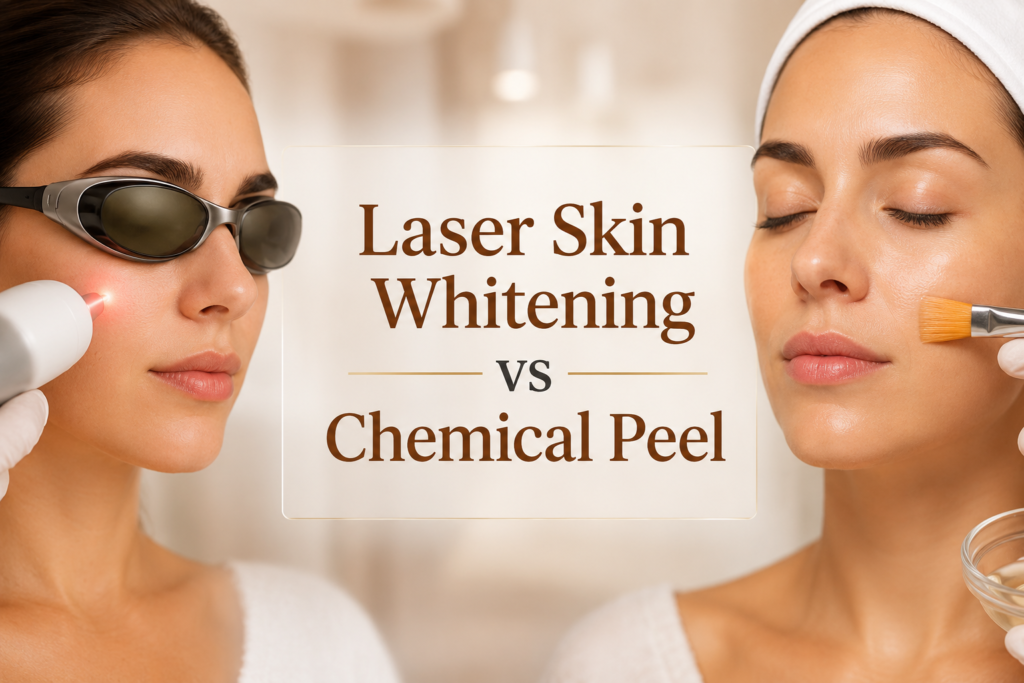
You have probably sat with your phone at 11 p.m., comparing before-and-after photos, reading contradictory Reddit threads, and wondering: laser skin whitening or chemical peel which one is actually worth it for my skin? You are not alone. In Karachi’s aesthetic market alone, these two treatments are among the top three enquiries every single week.
The honest answer is not as simple as “one beats the other.” Both deliver real, visible results. But they work differently, target different skin concerns, and suit different skin types and for South Asian skin in particular (Fitzpatrick Types IV–V), the choice matters a great deal. Getting it wrong does not just waste money; it can worsen the very concern you wanted to fix.
This guide is built for people who want the full picture before they book anything. We will cover the science, the real-world experience, the ideal candidate for each treatment, what results actually look like on brown skin, and how Caviar’s clinical approach in Karachi helps you make a confident, informed decision.
“The best skin treatment is the one matched precisely to your skin not the most popular one on social media.”
Why Skin Brightening Is More Complex on South Asian Skin
Before comparing treatments, it helps to understand why skin whitening and brightening concerns are so prevalent among South Asian women (and increasingly, men) in Pakistan. The answer is primarily biological.
People with Fitzpatrick Type IV and V skin the dominant skin types across South Asia have a higher concentration of active melanocytes. These are the cells responsible for producing melanin, the pigment that gives skin its colour. While melanin is actually protective (it shields skin from UV damage), these same melanocytes are highly reactive. Hormonal fluctuations, sun exposure, acne, inflammation any of these can trigger overproduction of melanin, leading to:
- Melasma the stubborn, symmetrical brown or greyish patches that often appear on the forehead, cheeks, and upper lip.
- Post-Inflammatory Hyperpigmentation (PIH) dark marks left behind after acne, breakouts, or any skin trauma.
- Uneven skin tone generalised dullness, patchy pigmentation that makes the complexion look tired or older.
- Sun damage accumulation gradual darkening from Karachi’s intense UV exposure, especially on exposed areas.
Both laser skin whitening and chemical peels address these concerns but they approach the problem from very different angles, and that distinction is critical when choosing between them.
What Is Laser Skin Whitening? A Precise, Targeted Approach
Laser skin whitening (also called laser skin brightening or laser pigmentation treatment) uses specific wavelengths of light energy directed at the skin to break up melanin deposits at their source. Unlike topical products that sit on the surface, laser energy penetrates the skin to work at the cellular level.
How the Technology Works
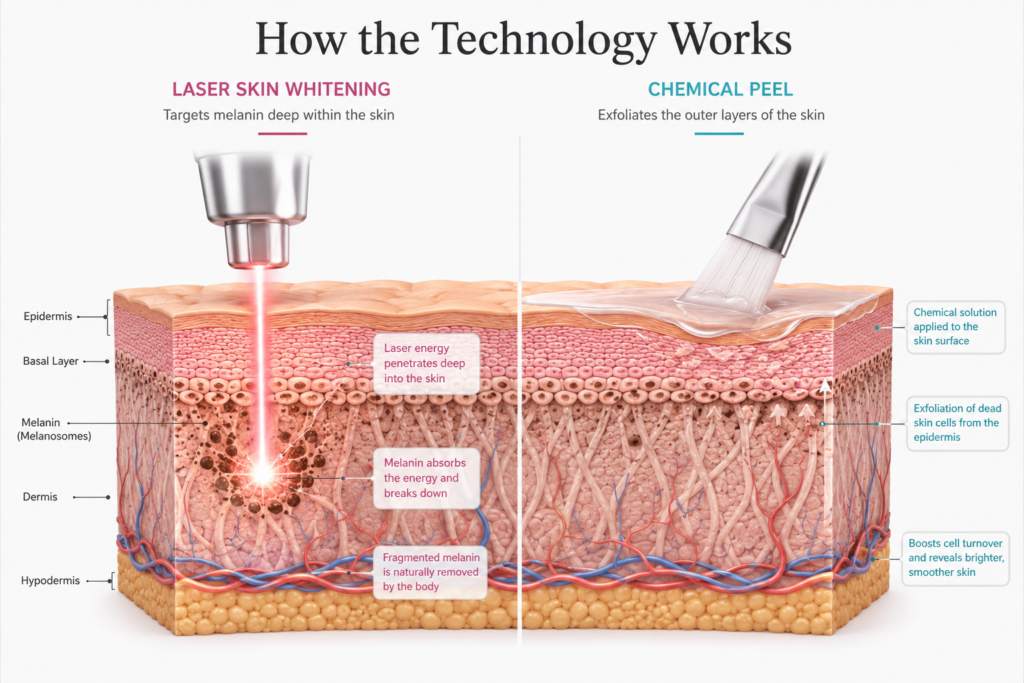
The science is rooted in a principle called selective photothermolysis the laser emits energy at a wavelength specifically absorbed by melanin (the dark pigment), generating heat that fragments the pigment clusters without significantly affecting the surrounding tissue. The fragmented melanin particles are then gradually cleared by the body’s immune system.
At Caviar, laser skin brightening is performed using world-class machines including the Revlite (Cynosure), the Q-Switch Helios III, and the Candela GentleYAG Pro-U all FDA-approved, American-imported systems. The choice of machine matters enormously. A Q-switch laser, for example, delivers nanosecond pulses ideal for targeting discrete pigmented lesions. The Revlite offers broader skin rejuvenation with a gentle toning effect across the full face.
🔬 Clinical Insight: Why Wavelength Selection Matters for Brown Skin
On darker skin tones (Fitzpatrick IV–V), wavelength selection is critical. The wrong laser or excessive fluence can trigger post-inflammatory hyperpigmentation meaning the treatment itself causes dark marks. At Caviar, every laser session begins with a skin analysis using the Smart Magic Mirror technology, which maps your exact pigmentation pattern and guides the settings used. This is why clinic selection matters as much as treatment selection.
What Laser Whitening Treats Best
- Melasma (including hormonally-driven melasma)
- Post-inflammatory hyperpigmentation (PIH) from acne
- Sun spots and UV-induced darkening
- Freckles and flat pigmented spots
- Overall dull, uneven skin tone requiring brightening
- Neck and décolletage darkening
The Typical Laser Whitening Experience
A session typically lasts 20–45 minutes depending on the treatment area. Patients describe a sensation of mild warmth or tiny rubber-band flicks tolerable for most without numbing, though a topical anaesthetic is offered for more sensitive clients. Immediately after, mild redness and warmth are normal and usually resolve within a few hours to a day. Most clients return to normal activity the same day.
Results are gradual and cumulative. After the first session, you may notice a subtle brightening. By the third or fourth session, the difference in pigmentation is typically visible and measurable. Maintenance sessions every 6–12 weeks help sustain results, particularly for melasma (which has a tendency to recur with hormonal triggers and sun exposure).
What Is a Chemical Peel? Controlled Skin Renewal from the Surface
A chemical peel is a skin resurfacing treatment that applies a carefully selected acid solution to the skin, inducing controlled exfoliation and cell turnover. As the old, damaged skin sheds, fresh new skin is revealed underneath with improved tone, texture, and clarity.
The word “chemical” understandably makes some people nervous, but it is worth noting that chemical peels have been used in dermatology for decades, are well-studied, and when performed by a trained professional using the correct formula for your skin type are among the safest and most effective skin treatments available.
Types of Chemical Peels Available at Caviar
Not all chemical peels are created equal. At Caviar, three clinical-grade peel systems are offered, each with different strengths and use cases:
- Cosmelan Peel A depigmentation-focused treatment that inhibits melanin synthesis at the enzymatic level. It is one of the most effective peels for melasma and hyperpigmentation on darker skin. Requires a home maintenance protocol post-treatment.
- VI Peel A medium-depth peel combining TCA, salicylic acid, retinoic acid, phenol, and vitamin C. Highly effective for pigmentation, fine lines, and acne-damaged skin. Popular among patients wanting visible brightening without extended downtime.
- Green Sea Peel A natural peel utilising marine micro-algae (sea plants) to induce gentle exfoliation. No synthetic acids; gentler on sensitive or reactive skin. Ideal as a starter peel or seasonal treatment.
The Chemical Peel Experience: What Actually Happens to Your Skin
The peel solution is applied to cleansed skin and left to work for a specified dwell time typically 5–30 minutes depending on the peel type. You may feel a tingling to stinging sensation (more intense with medium/deep peels). The skin may flush red during application.
Over the following days, peeling begins and this is where the results happen. With a VI Peel, for example, significant shedding typically occurs on days 3–5. The new skin underneath is brighter, smoother, and more even. This shedding phase is why downtime planning matters: many patients time their peels before a long weekend.
💡 Real Talk: The “Peeling” Stage
One of the most common questions at Caviar is: “Will I look terrible for a week?” With a superficial peel (like the Green Sea Peel), the peeling is minimal more like dry, flaky skin you might have in winter. With a medium peel like the VI Peel, you can expect noticeable shedding for 4–6 days. The payoff? Skin that looks genuinely renewed. Planning your peel for a Thursday gives the skin through the weekend to progress through the initial phase before Monday.
Laser Skin Whitening vs Chemical Peel: The Full Comparison
Here is the complete, side-by-side breakdown that most treatment guides do not give you covering every variable that actually matters when choosing between these two treatments:
| Factor | Laser Skin Whitening | Chemical Peel |
|---|---|---|
| Mechanism | Targets melanin using focused light energy | Uses acids to dissolve & shed dead/damaged skin cells |
| Best For | Deep pigmentation, melasma, dark spots | Surface dullness, uneven tone, mild hyperpigmentation |
| Skin Depth | Dermis (deep layer) sub-surface | Epidermis to upper dermis surface to mid-depth |
| Sessions Needed | 3 – 6 sessions typically required | 1 – 6 sessions depending on peel strength |
| Downtime | Minimal to none (1–2 days redness possible) | Mild (superficial) to 7–14 days (deep peels) |
| Pain Level | Mild warmth or tingling; tolerable | Superficial: none; Medium–Deep: stinging/burning |
| Results Timeline | 2–4 weeks post-session, gradual improvement | Superficial: 5–7 days; Medium: 1–2 weeks |
| Longevity | Longer-lasting with sun protection & maintenance | Requires repeat sessions every 4–12 weeks |
| Safe for South Asian Skin | Yes with correct wavelength selection | Yes lower-strength peels preferred |
| Ideal Candidate | Persistent melasma, PIH, uneven tone | Acne, dullness, fine lines, surface texture issues |
| Cost Range (Karachi) | Higher per session; fewer total needed | Lower per session; may need more sessions |
The Scenario That Changes Everything: Meet Alia
To make this comparison tangible, let’s follow a hypothetical but deeply realistic scenario. Meet Alia a 31-year-old marketing professional in Karachi.
Alia has the following concerns: a symmetrical, slightly grey-brown patch across both cheeks and her upper lip (a classic melasma presentation), and residual dark marks from a breakout three months ago on her jaw. Her skin is Fitzpatrick Type V. She works long hours and cannot afford more than a day of visible downtime. She has a wedding to attend in seven weeks.
If Alia Chose a Chemical Peel First…
A medium-depth peel like the VI Peel would address her PIH marks (from the breakout) effectively the acids resurface the skin and accelerate the natural fading of those marks. The brightening effect would also improve her overall tone. However, for her melasma which is hormonally driven and sits deep in the dermis a single VI Peel would offer limited improvement. Melasma at this depth does not simply peel away. Additionally, with a 7-week timeline before the wedding, the peel schedule would need to be timed carefully to avoid active peeling on the event day.
The recommendation here: the Cosmelan Peel, which specifically inhibits melanin production and addresses both concerns simultaneously, with a home maintenance kit to sustain results. Combined with SPF diligence non-negotiable with any peel her skin would show meaningful improvement within her window.
If Alia Chose Laser Whitening First…
The Q-Switch laser or Revlite would target both her PIH marks and her melasma at a deeper level. The advantage here is precision: the laser can treat her darker areas selectively without affecting surrounding skin. With two sessions in the seven-week window (sessions spaced 3–4 weeks apart), she would see progressive lightening of both her melasma and her PIH. Downtime is minimal mild redness for 24 hours after each session.
The caveat with melasma and laser: over-treating or using incorrect parameters on Fitzpatrick V skin can rebound causing post-laser darkening. This is why Dr. Ambreen’s approach always involves a pre-treatment skin analysis and a conservative first session to assess the skin’s response before escalating fluence.
The Caviar Verdict for Alia
“For Alia’s profile, the optimal approach is a combined protocol: a Cosmelan Peel to address the melasma enzymatically, followed by Q-Switch laser maintenance sessions after the initial healing phase. This is why cookie-cutter answers fail skin and why a clinical consultation is always step one.”
Dr. Ambreen Roshan, Caviar Clinic, Karachi
Which Treatment Is Right for Your Skin Concern?
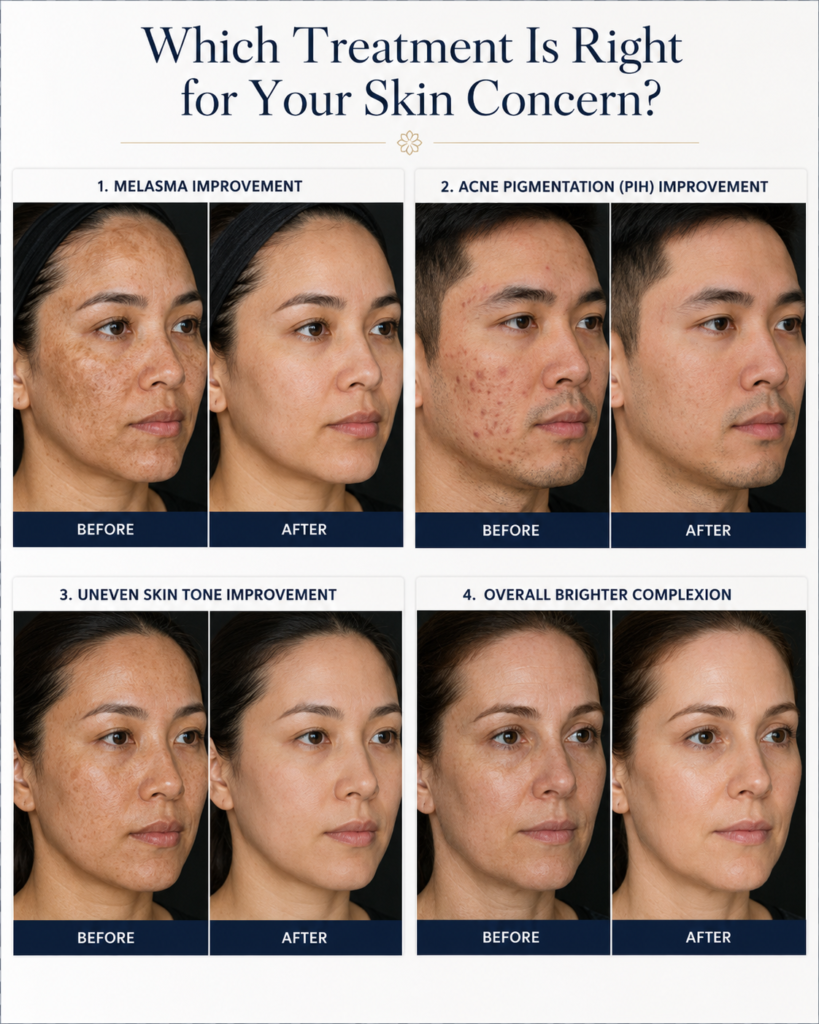
Based on clinical presentation, here is a practical guide to help you identify your starting point:
Choose Laser Skin Whitening If…
- Your primary concern is melasma particularly hormonal or deep-set melasma
- You have sun spots, freckles, or discrete pigmented areas you want to target precisely
- You cannot afford any significant downtime (even 3–5 days of peeling)
- You have previously tried surface-level treatments without sustained results
- Your skin is reactive or sensitive and you are concerned about peel-induced inflammation
- You want to treat the neck, hands, or body areas where chemical peels are less commonly used
Choose a Chemical Peel If…
- Your concern is post-acne marks (PIH) and surface-level uneven tone
- You want to address texture, enlarged pores, and dullness alongside pigmentation
- You have active or recently cleared acne and want to prevent and fade scarring
- You can schedule 4–7 days of lower social visibility for a medium peel
- You want a more budget-friendly entry point into professional skin brightening
- You are looking to improve the overall quality of your skin, not just target spots
Consider a Combined Approach If…
Many of our clients at Caviar present with multiple, layered concerns which is exactly why combined protocols exist. The Cosmelan Peel followed by Revlite maintenance sessions, or the VI Peel followed by targeted Q-Switch treatment, can address different layers of pigmentation simultaneously in a staggered protocol. These are planned in consultation with Dr. Ambreen to ensure the skin is not overwhelmed and that each treatment is timed to complement the other.
A Crucial Note on Safety for Brown Skin in Pakistan
This is the section most blogs skip and it is the most important one for a Pakistani audience.
A significant number of the aesthetic concerns brought to clinics in Karachi are iatrogenic meaning they were caused or worsened by treatments performed elsewhere, often with unregulated lasers or incorrectly formulated peels applied to darker skin tones without adequate understanding of Fitzpatrick IV–V physiology.
The risks of poorly performed treatments on darker skin include:
- Post-inflammatory hyperpigmentation (PIH) from over-aggressive laser settings or peel concentrations
- Hypopigmentation patches of lighter skin that can be permanent
- Chemical burns from unregulated peel formulations
- Paradoxical darkening of melasma from incorrect laser stimulation
This is not meant to alarm you it is meant to underscore the importance of choosing a medically supervised clinic using clinically validated equipment. At Caviar, all laser sessions are performed with FDA-approved machines, and every peel formulation is medical grade. The Smart Magic Mirror skin analysis before treatment is specifically designed to catch contraindications that a visual consultation alone might miss.
Complementary Treatments That Enhance Your Results
Neither laser whitening nor chemical peels operate in isolation the best results come when they are part of a thoughtfully layered skin programme. Here is what commonly complements these treatments:
Microneedling + Mesotherapy
Microneedling creates micro-channels in the skin that dramatically enhance the penetration of brightening actives, while mesotherapy for face delivers custom cocktails of vitamins, antioxidants, and depigmenting agents directly into the skin. When used 4–6 weeks after a laser or peel session, this combination accelerates results and improves skin quality at a deeper level.
→ Explore Microneedling at Caviar | Mesotherapy for Face & Hair
HydraFacial for Maintenance
The HydraFacial is the ideal monthly maintenance treatment between laser or peel sessions. It deep-cleanses, exfoliates gently, and delivers hydrating and brightening serums through a vortex suction system keeping the skin in optimal condition and prolonging the results of more intensive treatments.
→ Learn about HydraFacial at Caviar
Whitening Injections (Glutathione IV)
Glutathione the body’s master antioxidant administered intravenously (or via IM injection) works systemically to reduce melanin production from the inside. When combined with a topical peel or laser protocol, whitening injections address the hormonal and oxidative triggers of pigmentation that surface-level treatments cannot reach alone. This combination is particularly effective for stubborn melasma that has not responded to topical-only approaches.
→ Whitening Injections at Caviar
Glass Skin Facial Cocktail
The Glass Skin Facial Cocktail at Caviar is a signature treatment combining PRP/PRF therapy with targeted brightening boosters designed to give the luminous, poreless finish that laser and peels structurally improve, but texture-enhance in a single standalone session. Perfect as a special-occasion treatment in the weeks after a completed peel or laser series.
→ Glass Skin Facial Cocktail
Post-Treatment Care: The Part That Determines 40% of Your Results
This is the section patients absorb least carefully and it is the section that most directly affects how long your results last.
After Laser Whitening
- SPF 50+ is non-negotiable. Karachi’s UV index averages 10–12 in summer months. Post-laser skin has reduced melanin and is more susceptible to UV-triggered re-pigmentation.
- Avoid direct sun between 10 a.m. and 4 p.m. for at least two weeks post-session.
- No harsh actives (retinol, AHA, vitamin C in high concentrations) for 5–7 days.
- Keep skin well-moisturised barrier support accelerates healing and prevents PIH.
- Avoid steam rooms, saunas, and intense exercise for 48 hours (heat can prolong redness).
After a Chemical Peel
- Do not pick, peel, or assist the shedding process premature removal of peeling skin can cause PIH.
- Use only the prescribed post-peel recovery products provided by Caviar no new actives until cleared.
- SPF is even more critical immediately post-peel new skin is extremely UV sensitive.
- Expect dryness and tightness; a gentle, fragrance-free moisturiser is your best friend for days 3–7.
- Cosmelan Peel patients: adherence to the home-use depigmentation cream is essential for the protocol to work as intended.
“Sunscreen is not a finishing step it is the treatment. Without it, neither laser nor peel results will hold.”
Dr. Ambreen Roshan
Cost Comparison: Laser vs Peel in Karachi (2026)
Cost is always a genuine factor and we believe in transparency about it. Here is the realistic framework for budgeting both treatments in Karachi at a medically supervised, premium clinic:
Laser skin whitening sessions at a reputable clinic using FDA-approved technology typically range from PKR 8,000 to PKR 30,000+ per session depending on the machine used, the area treated, and session depth. A full protocol of 4–6 sessions places the total investment in the PKR 40,000–PKR 150,000 range over 3–5 months. However, results last significantly longer and the interval between maintenance sessions (once stabilised) is longer.
Chemical peels vary considerably by type. A superficial peel may be PKR 5,000–PKR 12,000; a Cosmelan Peel (which includes the home kit and follow-up protocol) is a more significant investment but is purpose-built for the most stubborn pigmentation concerns in darker skin. VI Peel sessions fall in the mid-range.
💰 The Real Cost Calculation
When comparing total investment, factor in the number of sessions required over a year, the cost of maintenance, and the quality of results. A cheaper peel repeated 8 times with limited results for deep melasma costs more in time, money, and frustration than a well-planned 4-session laser protocol that delivers lasting clearance. The cheapest treatment is the one that actually works for your specific concern.
Frequently Asked Questions
Is laser skin whitening safe for Pakistani skin?
Yes when performed using the correct wavelength settings and FDA-approved equipment by a trained medical professional. The key risk on Fitzpatrick IV–V (South Asian) skin is post-inflammatory hyperpigmentation from excessive fluence. At clinics like Caviar, a pre-treatment skin analysis and conservative initial settings mitigate this risk. Avoid non-medical laser clinics or spas for this treatment.
Which is better for melasma: laser or chemical peel?
For most melasma presentations on South Asian skin, a depigmentation peel like Cosmelan is often the first-line clinical choice because it inhibits melanin synthesis at the enzymatic level. Laser can be highly effective particularly Q-Switch and Revlite but requires expert settings to avoid paradoxical darkening. For stubborn, hormonally-driven melasma, a combined approach (peel + laser maintenance + sunscreen diligence) typically delivers the best long-term outcome.
How many laser whitening sessions are needed to see results?
Most patients notice initial brightening after 1–2 sessions. Meaningful, sustained improvement in pigmentation typically requires 3–5 sessions, spaced 3–4 weeks apart. Results continue improving in the weeks between sessions as the body clears fragmented melanin. Maintenance sessions every 8–12 weeks are recommended for conditions like melasma that have ongoing triggers.
Does a chemical peel hurt?
Superficial peels (Green Sea Peel) cause minimal to no discomfort most patients describe a very mild tingling. Medium peels (VI Peel) produce a more noticeable stinging sensation during application that typically resolves within minutes. Numbing agents are not usually required but can be used on request. The “pain” associated with chemical peels is generally well within the tolerance range of most patients.
Can I combine laser treatment and a chemical peel?
Yes, but not simultaneously and not without a structured protocol. Typically, these treatments are staggered for example, a Cosmelan Peel is performed first, the skin is allowed to heal and stabilise over 4–8 weeks, and then Q-Switch laser sessions are introduced to maintain and deepen the pigmentation clearance. Dr. Ambreen designs these protocols individually based on skin analysis never a generic template.
How long does it take to see results from a chemical peel?
Superficial peels show brightening within 5–7 days once the initial shedding resolves. Medium peels (VI Peel) deliver visible improvement in tone and texture within 10–14 days of treatment. The full benefit of a Cosmelan Peel protocol develops over 4–8 weeks as the melanin suppression effect takes hold. Ongoing home maintenance is key to sustaining these results.
Can laser or peels permanently lighten skin?
“Permanently” is a word to approach carefully in aesthetics. Both treatments reduce existing pigmentation and with consistent sun protection and maintenance results can be sustained long-term. However, melanin production is an ongoing biological process. Hormonal changes, UV exposure, and inflammation will continue to stimulate melanin production. What both treatments offer is a significant reduction in existing pigmentation and a framework for managing recurrence with periodic maintenance.
What should I avoid before a chemical peel or laser session?
In the 1–2 weeks before treatment, avoid: retinoids (tretinoin, retinol), exfoliating acids (AHAs, BHAs), waxing or threading on the treatment area, excessive sun exposure, and any new skincare products that could sensitise the skin. You should also inform your clinician about any medications you are taking, particularly photosensitising drugs, blood thinners, or hormonal treatments, as these can affect treatment safety and outcomes.
Why Karachi Patients Choose Caviar for Skin Brightening
In a city where aesthetic clinics have multiplied faster than quality controls, Caviar by Dr. Ambreen Roshan has become the reference point for medically rigorous, results-driven skin care in DHA Karachi. Here is what sets the approach apart:
- Smart Magic Mirror Skin Analysis Every new patient receives a comprehensive skin analysis using AI-assisted Smart Magic Mirror technology before any treatment is planned. This maps pigmentation depth, skin texture, hydration, and pore condition, guiding precise treatment selection.
- FDA-Approved American Machines Only The Revlite (Cynosure), Q-Switch Helios III, Candela GentleYAG Pro-U, and Soprano (Alma) are all FDA-approved and imported from the United States. No grey-market or unvalidated equipment.
- Medical-Grade Peels Cosmelan, VI Peel, and Green Sea Peel are all professional-grade, clinically validated formulations not the salon-strength versions that sometimes create more problems than they solve on darker skin.
- Dr. Ambreen Roshan’s Oversight Every treatment protocol is designed and supervised by Dr. Ambreen herself a qualified aesthetic dermatologist with a track record across hundreds of successful pigmentation treatment journeys on South Asian skin.
- Personalised Protocols, Not Packages Caviar does not sell packages. Each patient receives a personalised treatment plan based on their specific skin analysis, concerns, timeline, and budget with no pressure to commit to more than they need.
Ready to find out which treatment is right for your skin? Book a consultation at Caviar’s DHA Phase 6 clinic and receive a full skin analysis before any treatment recommendation is made. Walk in with questions walk out with a plan built specifically for your skin.
Explore Related Treatments at Caviar
Based on the treatments discussed in this guide, these service pages offer additional detail and consultation booking for each:
- Chemical Peels at Caviar Cosmelan, VI Peel & Green Sea Peel | The full peel menu with clinical details for each formula.
- Laser Treatments at Caviar Revlite, Q-Switch, Candela & Soprano | Advanced laser technology for pigmentation and hair removal.
- Microneedling Collagen Induction for Texture & Tone | Ideal for PIH and skin texture concerns alongside brightening.
- Mesotherapy for Face Targeted Brightening Cocktails | Vitamin-rich micro-injections that enhance pigmentation treatment.
- Whitening Injections (Glutathione IV) Systemic Brightening | Addresses the hormonal triggers of pigmentation from within.
- Face PRP Platelet-Rich Plasma for Skin Renewal | Collagen and glow boost that complements laser and peel protocols.
- Cosmelan Peel Dedicated Page | Full details on the gold-standard depigmentation peel for melasma.